On Lessons of Darkness (1992), and other films.
Dir. Werner Herzog – Kuwait & Germany – Documentary (Essay Film)

In the past, I have described to my uninitiated friends that Herzog films let you feel a new emotion, an unlikely cocktail of wonder & astonishment with dread & horror. Undeniably beautiful images which fringe on abstraction of their subjects which portray such tectonic turmoil in the Earth’s terrain or even the landscape within characters themselves, that you are left in a third stream altogether different from the sum of its parts – the Sublime. The Romantics experienced the Sublime, a mixture of deep amaze with melancholy, in a creeping existential reaction to nature, its permanence and human temporality. The awareness of the glacial march of the Earth, breathing in and out as lifetimes pass on its surface.
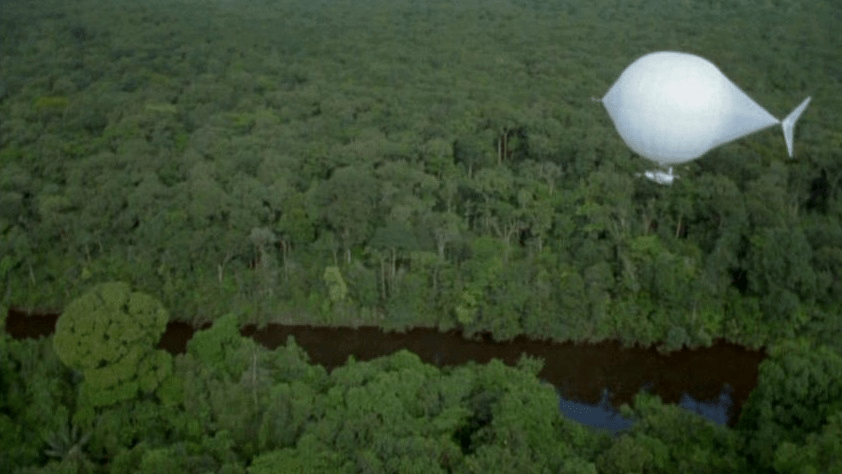
Herzog’s views are often described as nihilistic. He’s seen as a Teutonic titan of a character who can shut down interviewers who don’t know what they’re talking about, or reduce his films down to simple concepts. In the right hands, he can blossom into a uniquely poetic essayist who understands his philosophy inside out, far from the pessimist it’s easy to portray him as. But even in these moments I have always seen him as a romantic, and even though he portrays deep, dark madness in a lot of his fictions, and fate and the inevitability of nature etc in his documentaries, I believe at heart he is an optimist. When championing unique characters, like Graham Dorrington in the White Diamond (2004), and their perseverance against the impossible odds, even when his characters are insane, hateful psychopaths, you cannot help but share their wonder. All the same, they gaze longingly into the far distance, well past the horizon. Though his eye skews more often towards dread, his disposition is still that of a Romantic at heart.
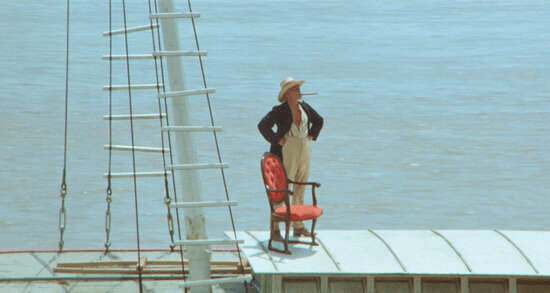
Where Kant’s Sublime was something whose immensity escaped the power of human judgement, Herzog challenges us: where the Sublime we are experiencing in Lessons of Darkness – antithetical to all his other films – is man-made. The Sublime of Carl Gustav Carus and his Romantic contemporaries was the natural world, but here, the epic walls of fire and apocalyptic imagery are consequences of conflict. Something so beautiful, so infernal and otherworldly, yet so innately human. It’s easy to compare the landscape to Hell, something that was both written about, and created by humans.
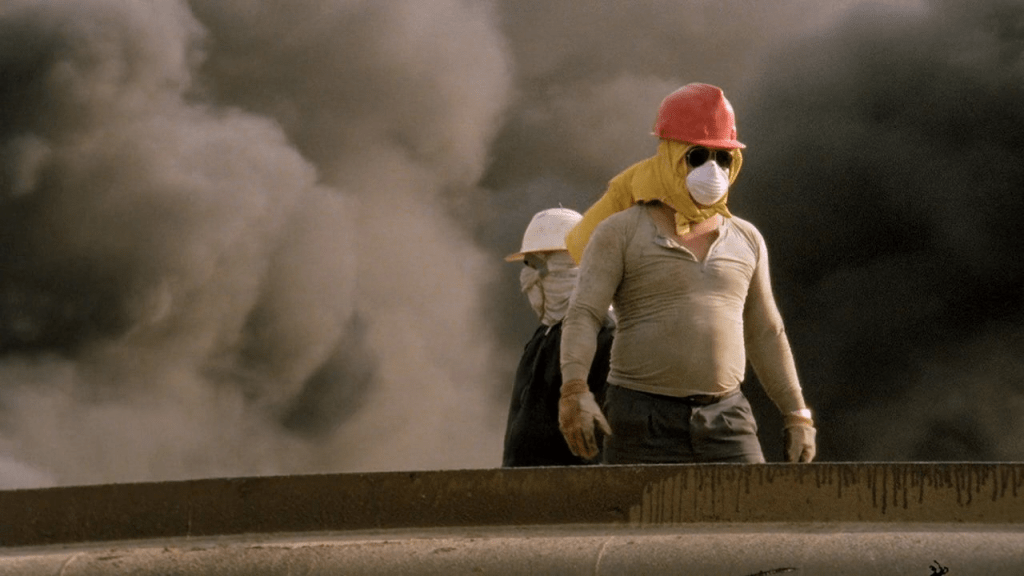
Herzog’s use of the Rückenfigur is also unorthodox. The characters regarding belching smoke aren’t anonymised by their ignorance to their documentation – instead, we actually open the picture with the director’s narration insisting that the alien was attempting to communicate to the filmmakers – they are covered up, showing little in the ways of human features other than their silhouette and a little flesh for ventilation. But they do remain basically anonymous, dwarfed by an ersatz troposcape.
In the last 2 decades of his almost 7-decade career, the director has followed more innocent and optimistic personalities than his early works were permeated by. Clive Oppenheimer, Timothy Treadwell, Graham Dorrington (as previously mentioned), Katia and Maurice Krafft – all these people, for me, are characterised by a buoyant worldview, an uncrushable spirit in the face of the Sublime. These people, often to their own detriment, welcome the Sublime, the danger it invites, and are more than contented with the consequence. They are more than aware of the poetry, without a hint of irony, of expiring from the thing they sought to lovingly document.
I agree with the Minnesota Declaration, that there does exist a deeper, ecstatic truth, that there is no truth but the accountants’ truth in vérité. These idealists live a life close to that ecstatic truth, and this is what attracts Herzog with them. They already carry within them a personal spiritualism matched by the subjects of so few other documentarians, and is what attracts Herzog to their stories, their auras, and their philosophies. These people thrive off facing down the Sublime – the harsh desert of the Antarctic, the grizzlies of Katmai, the canopy of the Amazon, the stratovolcanoes of the Ring of Fire. These aren’t characters that Herzog has to create – although his Shakespearean mixing of reality and creation would easily allow fictionalised accounts – and as such they are films ready to be made. Herzog need only switch his camera on.
There exists a dialectic upon investigation, where it could be proposed that Herzog’s true personal Sublime are his subjects themselves. Of their ilk, insane or wonderous (a hair’s breadth separating them), the director’s awe is aimed part at their world and part at them themselves. Far lesser-known documentaries in his filmography display this on a purer level, notably the twin 1981 featurette releases of Huie’s Sermon and God’s Angry Man, and the even rarer-discussed How Much Wood Would a Woodchuck Chuck. The power of speech would be an underselling link between this trilogy, but it remains true. The two former focus on high-octane preachers, the titular Huie delivering a gasping bellows-driven sermon in a Brooklyn church, and Gene Scott a force of nature on televangelist programme Festival of Faith. Each seem to be possessed by a higher power – the director allowing each subject to take centre stage. The latter centres on the 1976 World Livestock Auctioneer Championship taking place in Pennsylvania, and the speed and volume of dialogue on display.
All 3 of these films allow the camera to run and run and run, past the point of delirium, all the way to abstraction. Each speech begins and the audience try to parse for the semantic and rhetorical – fighting a losing battle. Then comes an attempt in understanding the tone and texture and cadence of the voice of the orator, a menial task when the words all exist in homogeneity. The slow slide into total dissociation after several minutes, depending on the listener’s focus, allows us to observe non-subjectively the sheer volume of sound, both in terms of amplitude and tempo, and impresses us with complete prosodic maximum.

These films and characters do differ in their wonderment from those previously mentioned, in that they become almost entirely spectacle, and, as such, although I hate to say it, Herzog’s style becomes not unlike vérité; it loses some of the ecstasy which is observed in later documentary works. But they are still a similar source of wonder in the same oeuvre – they present a physical trait or phenomenon of capability where other subjects’ proximity to and nonpareil ardour for acts of nature are their pageantry. Not so different really.
Lessons of Darkness displays little of these characterful properties. In this light, our oilslick Rückenfigur is far more orthodox, even when he faces and marshals to the lens. Cursorily there is little in the way of romance in Lessons of Darkness – it surely is one of the darkest, most horrific films ever put to print, even without showing directly any of the atrocities committed in the Gulf War all for the sake of oil. Stood at the nadir of another decade of senseless capitalist conflict, Herzog’s alien observations offer little optimism, painfully aware of his heritage and the Marxist axiom. And yet we are instilled with reverence, and awe – liberal use of Wagner with healthy doses of Romantic composers such as Schubert, Mahler, and Grieg, their giant walls of sound, and seat-shaking sonorosity of brass sections slakes fear and horror for unsteady unease. Now we can see the flames and oil geysers through a Doc Edgertonesque lens.
Lessons of Darkness is available on YouTube. As are God’s Angry Man and The White Diamond. I highly recommend all of Herzog’s work where you can get it. He says piracy is the most successful form of distribution but that’s not up to me to say.
 The Mezzanine