At Teatralia‘s 29th edition, Madrid’s city-wide annual theatre festival “for the whole public” this year, I came across this curious genre label applied to a show named FIVE LINES, and I just had to know more. As a cinema fan with a track record of enjoying collage media, it piqued my interest more than just a little.
The show promised itself to “combine the languages of theatre, audiovisual art, and live music”, and it did just that. It’s difficult to describe the complexity of the operation. Using a combination of models, cut-out figures on bases like flattened Subbuteo players, toys, their smartphones, and print, the audience is drawn into the post-apocalyptic world with the show’s creators, who play themselves onstage and control miniature versions of themselves.
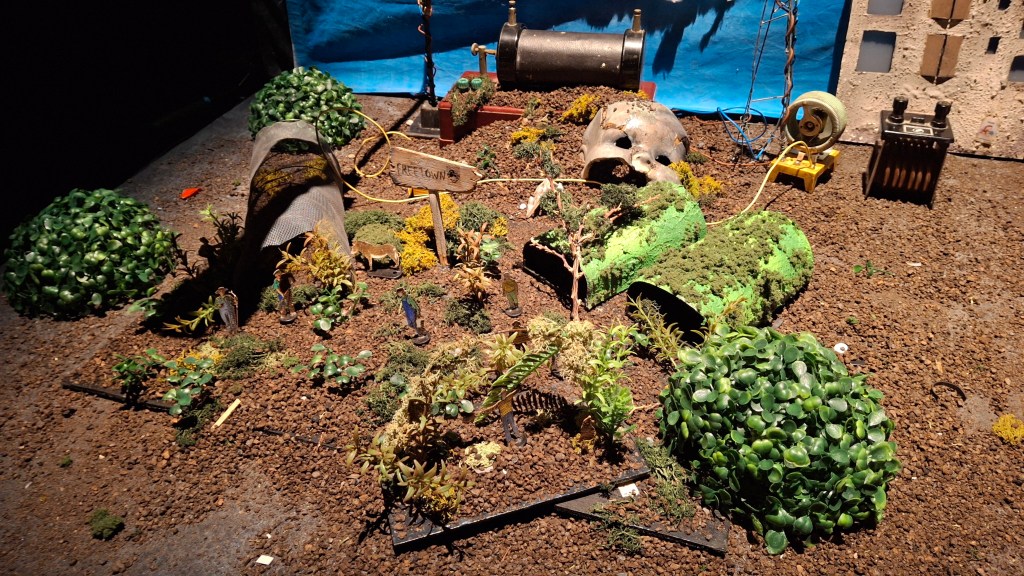
A screen behind the various onstage tables (or perhaps, onstage stages?) displays images from any of the 4 cameras present, or pre-recorded videos and animation from within the world that the characters occupy. We move from before the climate disaster occurs, to after – from indoor sets, to outdoor. The protagonists serendipitous meeting, their life together in its wake, and how, bound together, they drifted in the aftermath of the sudden destruction of life as they know it. Soon, an idiosyncratic, alternatively fast- and slow-talking character appears on television screens, promising a return to normality, if only they follow him underground. Like popular dramas such as Silo, or videogame franchise Fallout, surely this can only be successful!?
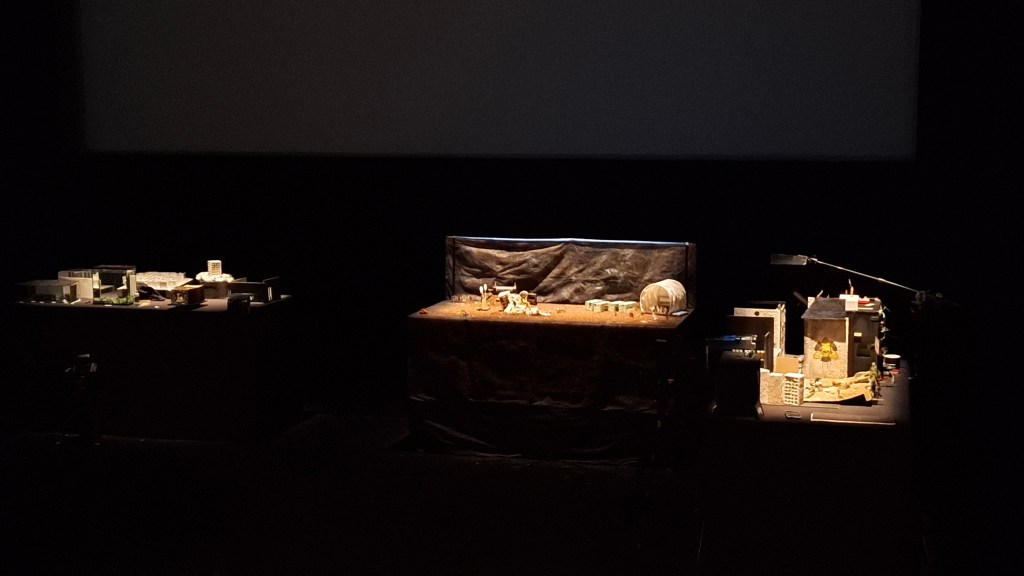
Our protagonists tentatively follow suit, and upon arrival, are given new clothes. Each performer leaves the stage, and suits up, remaining clad in aptly angular and uniform synthetic jumpsuits for the rest of the show. They then sign, perhaps in blood, the terms and conditions of cohabitation – “sacrifice your freedoms for your security” is what they were told. And so they did…
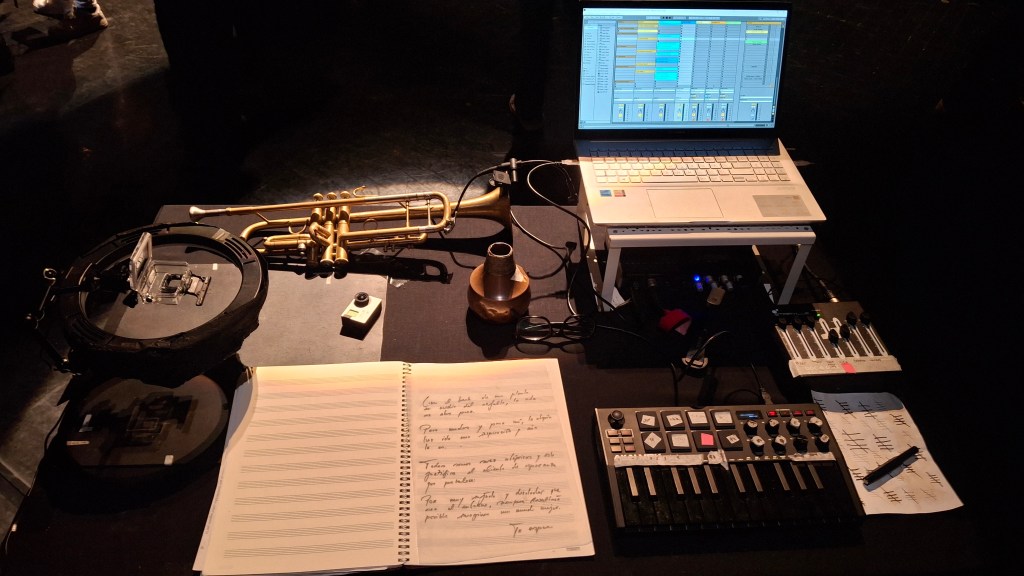
As the story progresses, we fluidly cut between cameras, and, although the movement is sometimes jerky, everything carries on smoothly. I thought about the sheer amount of rehearsal necessary and how long the cue sheet must have been. Each transition and each cut requires camera motion, sometimes dollying on a tripod, switching feeds, moving characters and props, and controlling lighting cues. The effort put into the choreography must have been immense! Each of three performers is simultaneously a puppeteer, camera operator, and lighting technician. Matteo, the fourth, to the side, operates stage lighting cues, triggers voiceover, and plays sections of melancholy trumpet music. Every company member wears so many hats.
The minimalist sets and a heavy use of a shallow focus field through the DSLRs allow a still and simple scene to develop. It isn’t an action-packed drama, but it lends you the means to appreciate the work put into each miniature and the mise-en-scène. And that I certainly did.
FrauTrapp – a portmanteau of its founders’ last names – clearly has so many talents in reserve that they wouldn’t and couldn’t possibly be held back to a single medium, and as far as I know, are some of the pioneers of this niche of cinema and theatre. My singular impressive experience of their work, not so long after my wonderful experience volunteering at Beverley Puppet Festival in 2024, has lead me to see the boundless creativity of the world of theatre and puppetry. I will be on the hunt for more shows like it throughout the UK.
You can view the trailer for FIVE LINES here.
 The Mezzanine