This Lithuanian documentary walks the line between discomfort and pain in following its distressing subject. Inta, a single woman living in the middle of a forest, is totally cut off from society, and it is clear that this has had quite some effect on her psyche.
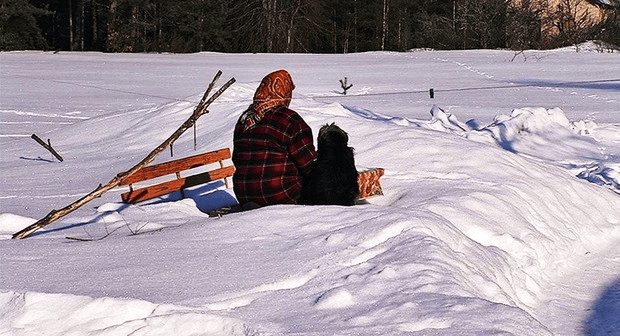
Zviedris, co-director, camera operator, and interviewer for the film, turns up seemingly out of the blue one day at Inta’s cabin, camera in hand, and thus begins the abuse. Profanities fly, doors are slammed, and from the audience’s perspective, it almost seems like harassment. This is the simple theme of the film. Zviedris visits Inta, receives some abuse, but little happens. It is frustrating, confusing, unsettling, and doesn’t actually make for good cinema on the surface. It feels like an anti-film piece of performance art.
There is no doubt in my mind that Zviedris doesn’t know what he is doing, but really, for so long, I struggled to understand the aims of this film. It raises a myriad of questions that I don’t think I can satisfactorily answer – foremost being: why? The man seems to have an infinite reservoir of energy to keep nearby Inta, to carry on every conversation that ends with the same abuse, to keep filming every interaction. Immensely frustrating and confusing to get to grips with when not viewing it completely and utterly open-mindedly. It essentially resembles a psychological profile of a real specimen of a human being, in isolated circumstances, but at what point does it start to go in circles? For the majority of the film she sees him as an enemy, and I began questioning if he was as mad as she was, to keep coming back.
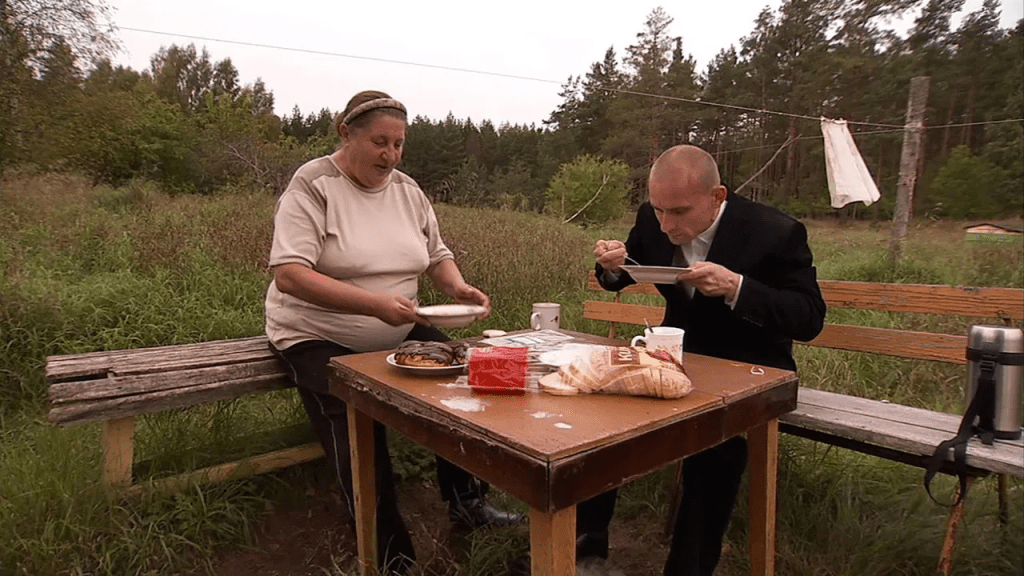
Inta asks Ivars repeatedly throughout the runtime, and as seasons pass from winter to summer, “what’s the point?” and, “you’re wasting film,” she tells him. He responds only, “it’s art.” And he’s right. I think he’s taken a very broad portrait of an extremely defensive, vulnerable woman, secluded from society. She immediately takes offence to his presence, let alone the proposition of his filmmaking, and by the end, despite the same profane responses to his questions, she ends up confessing her need for him in her own backward way, and through this, her love for him. Through the whole film you cannot see through her shell that she was the one being abraded all along.
And Zviedris. How selfless. Although maybe up to the point of making this film. But his art not only connects us with someone deeply damaged and flawed, though ultimately loving, seeking to help her through her isolation, but he connects with her himself with her too. I suppose it all depends on whether or not he stayed in contact with Inta after the filming period had ended. I’d be fascinated to read what he had to say about his experiences, his ideas, his process, and the aftermath of the film, whether the subject ever managed to see the complete artefact.
I realise how pure a film this is. And how beautiful some of the footage can be. Its simplicity really does elude any analysis other than asking questions and projecting your own responses to the footage. I implore you to try watching it if you can stand it or see it the same way.
 The Mezzanine